
MyAptitude evidence for Hong Kong schools
Registered with the British Psychological Society, with age-related norms and decades of psychometric work behind it
For Career and Life Planning teams and university counsellors in Hong Kong schools
Once known as the Cambridge Profile Aptitude Tests, MyAptitude holds British Psychological Society registration and has age-related norms built from large samples of students. Schools and colleges across the UK use it, and so do British international schools. MyAptitude is available in 22 languages, including Traditional Chinese and Simplified Chinese. For Hong Kong counsellors and Career Team teachers, this page gives the evidence in three parts: standards and norms, the psychometric research, and how schools put it to use.
Evidence you can share with school leadership
For Hong Kong schools, the headline facts are these: the British Psychological Society registers MyAptitude, each reported scale passes the accepted reliability threshold, and scores correlate with GCSE and A level outcomes, the qualifications many international schools in Hong Kong work towards.
In brief
The first three questions university counsellors and Career Team teachers tend to ask. You’ll find each answered, with its source, lower down.
ABILITY
Eight tests of ability
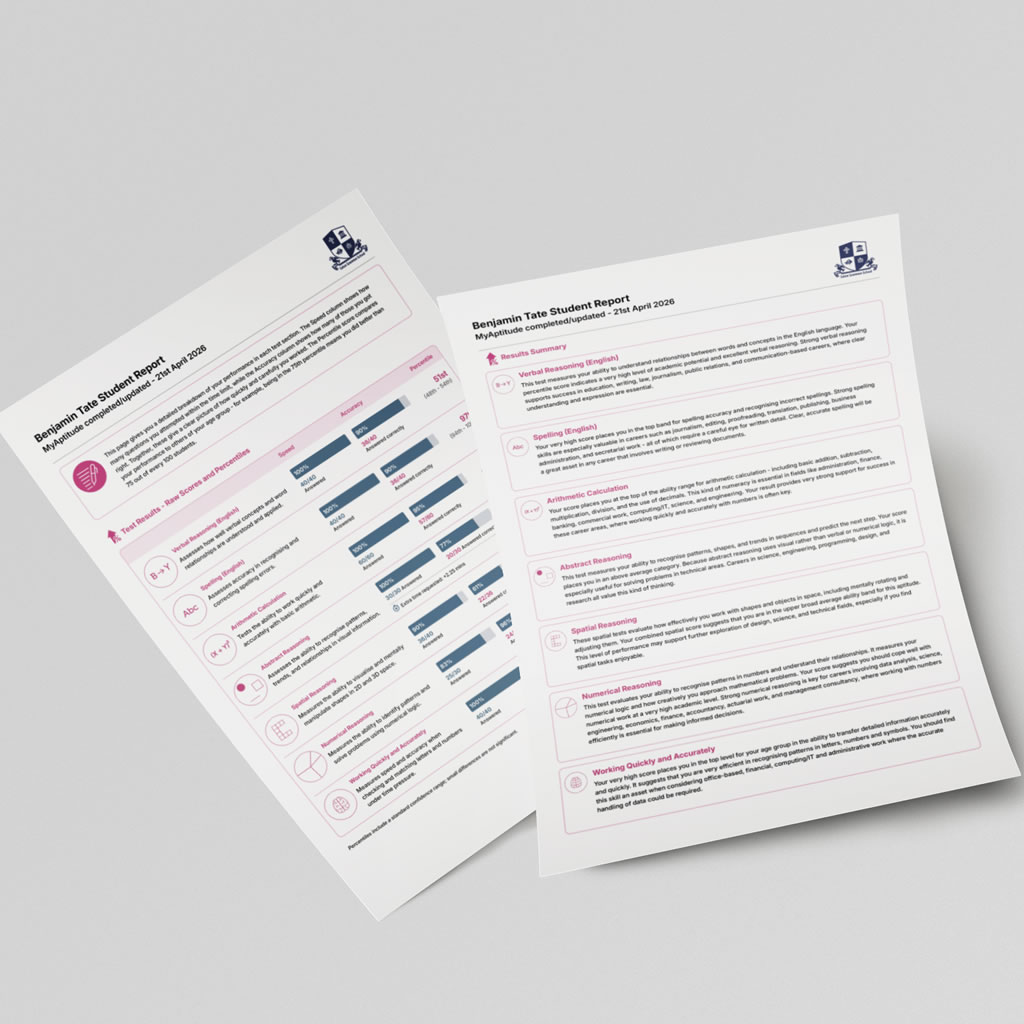
Timed tests of verbal, numerical, abstract and spatial reasoning, plus arithmetic, spelling, and working quickly and accurately.
NORMS
Compared with the right peers
Each student is measured against age-related norms, so their results are compared with peers in the same year and age group.
MyCareerChoices brings in each student’s interests, so counsellors can read strengths and interests side by side.
RELIABLE
Consistent across every scale
On every reported scale, internal consistency clears the accepted coefficient alpha of 0.70.
MyAptitude carries British Psychological Society registration, and its developer is Chartered Occupational Psychologist Dr Charles Johnson.

Standards and registration

How schools use it
Research that supports the scores
Before adopting an aptitude assessment, a school should know who students are measured against, how consistent its scores are and whether it measures what it claims. MyAptitude’s answers:
Age-related norms
Built from the first trials in 1999 and a later paper-and-online study, giving age-related norms for each year and age group.
Confidence ranges
Each percentile carries a standard confidence range, so small differences between scores are not read as significant.
Reliability
Every scale we report clears a coefficient alpha of 0.70, and the technical evaluation holds the complete figures.
Construct validity
Across every norming sample the same four-factor structure appeared, and aptitudes linked to interests in the ways expected.
Criterion validity
There are significant correlations between scores and GCSE and A level outcomes.
Independent research
Roberts (2004), in a PhD study, found that several MyAptitude measures predicted how medical students did in their first-year exams.
Sources: the MyAptitude Test Manual (2017); the Cambridge Profile evaluation summary; Roberts (2004). Ask us for the technical evaluation
The standards MyAptitude is built to
MyAptitude’s development and technical evaluation were led by Dr Charles Johnson, a Chartered Psychologist and Associate Fellow of the British Psychological Society. Between 2000 and 2005 he chaired the BPS Psychological Testing Centre and its Steering Committee on Test Standards. His career includes heading test development at the Cabinet Office’s Recruitment Research Unit, lecturing in psychology and statistics at UCL, and designing tests for the Foreign Office, Prudential, KPMG and test publishers. The British Psychological Society registers MyAptitude’s assessments.
MyAptitude is for low-stakes guidance, so scores are not used to select students, and suitably qualified staff should run and interpret it: Career Team teachers, careers masters and mistresses, or university counsellors. Read more about the MyFutureChoice approach to assessment here.

A long-established assessment
1999: the first trials of the Cambridge Profile Aptitude Tests, now MyAptitude, gave the assessment its original age-related norms.
Today: students take MyAptitude online as a digital battery of ability and aptitude tests, with an optional Verbal Reasoning test in 17 languages, including Traditional Chinese and Simplified Chinese.
From the Test Manual
“MyAptitude Test Manual” (2017) holds the full research record behind this page.
Putting the evidence to work in school
Careers teams in Hong Kong can use MyAptitude to set an objective measure of each student’s strengths beside their interests, teacher insight and predicted grades, for instance before S3 elective choices for the HKDSE, IB or A level subject decisions, or university applications. Every percentile comes with a standard confidence range, so staff can see when a gap between two scores is too small to matter and should not drive a decision.
Where schools use MyFutureChoice, students combine it with MyCareerChoices to read interests and abilities together, then explore careers in WORKBRIEF and shortlist university courses in MyUniChoices.
How to weigh this evidence
No one score should settle an elective, subject or university choice.
Links with exam results hold across groups of students; they do not predict any one student’s career.
Read aptitude alongside interests, teachers’ views and predicted grades.
Your careers teachers and counsellors make the call; MyAptitude informs their judgement.
Source: MyAptitude Test Manual (2017).
TRY IT FREE
Practise a career aptitude test for free
Curious about the tests before your school books the full assessment? Every practice test is a brief, timed taster of one MyAptitude test with a few sample questions. They cost nothing and need no registration.







The practice tests don’t compare anyone with other students. Percentiles and a full report come only from the complete MyAptitude assessment, which your school arranges.
Ask for the technical evaluation
Ask and we’ll send the complete evidence pack, covering norming samples, reliability and validity data and the psychometric background, for your school’s due diligence or purchasing review.